
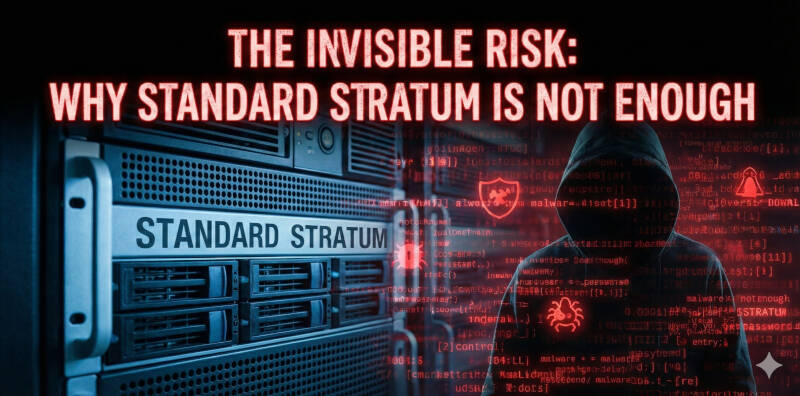
The Invisible Risk: Why Standard Stratum Is No Longer Enough for Secure Mining
In the high-stakes world of cryptocurrency mining, efficiency is usually the primary metric. Miners obsess over hashrate, power consumption (Watts per Terahash), and cooling solutions. Massive investments are poured into the newest ASICs and infrastructure to gain a competitive edge. Yet, amidst this race for hardware supremacy, a critical soft underbelly often remains exposed: the communication protocol itself.
For over a decade, the "Standard Stratum" protocol (specifically Stratum V1) has been the unseen backbone connecting mining hardware to mining pools. It works. It’s ubiquitous. And for modern mining operations, it is dangerously obsolete.
Relying on standard Stratum configurations today introduces an "invisible risk"—a threat vector that doesn't show up on a thermal camera or a power meter, but one that can silently siphon profits and compromise entire operations. Here is why standard Stratum is no longer enough and why the industry must evolve.
The Legacy of Stratum V1
To understand the risk, we must understand the origin. The original Stratum protocol was developed in a different era of crypto. It was designed for simplicity and ease of adoption when mining was far less industrialized. It solved the immediate problem of efficient communication between miners and pools better than previous HTTP polling methods.
However, Stratum V1 was built without a modern security mindset. It prioritizes connection speed over connection integrity. In today's threat landscape, where mining operations are lucrative targets for sophisticated cybercriminals, this legacy architecture is a liability.
The Core Dangers of "Standard" Configurations
The "invisible risk" of standard Stratum stems from three fundamental flaws inherent in the base protocol when left unhardened.
1. The Glaring Lack of Encryption (Plaintext Peril)
The most critical vulnerability in standard Stratum V1 is that, by default, communication occurs in plaintext. Data packets travel between your mining rig and the pool server unencrypted.
This is the equivalent of sending cash through the mail in a clear plastic envelope. Anyone situated between your operation and the pool—an ISP, a compromised router, or a sophisticated state actor—can perform a "Man-in-the-Middle" (MitM) attack. They can easily read the traffic, see exactly what your miners are doing, and, more alarmingly, modify that data in transit.
2. Hashrate Hijacking
Because the traffic is unencrypted and lacks robust authentication mechanisms, attackers can execute "hashrate hijacking."
In this scenario, an attacker intercepts the communication stream. Your miners are doing the hard computational work, submitting valid shares to what they think is your chosen pool. However, the attacker quietly rewrites the destination address or the worker credentials in the packets. The result? Your electricity pays for the attacker's payouts.
This risk is often "invisible" because your dashboard might still show active miners, but the actual revenue is being diverted silently. You may only notice when your pool payouts don't match your theoretical hashrate over an extended period.
3. Data Efficiency and Latency Bloat
While less nefarious than hijacking, standard Stratum V1 is inefficient by modern standards. The protocol is verbose, using human-readable JSON-RPC messages. At an industrial scale, with thousands of machines communicating simultaneously, this creates unnecessary bandwidth overhead.
This "bloat" increases latency. In crypto mining, latency equals lost revenue. If your valid share arrives at the pool milliseconds later than a competitor’s due to protocol inefficiency, their share is accepted, and yours becomes a stale share—wasted energy and zero profit.
The Necessary Evolution: Moving Beyond the Standard
Sticking to the default Stratum setup is a gamble where the house (the attacker) increasingly has the advantage. Mitigating this invisible risk requires proactive steps to harden the infrastructure.
Adopting Stratum V2
The definitive solution to these issues is the migration to Stratum V2. This is a ground-up redesign of the mining protocol.
Stratum V2 addresses the invisible risks directly:
Binary Protocol: It is far more efficient, reducing data loads and latency significantly.
Built-in Encryption: Security is not an afterthought; authenticated encryption is mandatory, making MitM attacks virtually impossible.
Information Leaks Prevented: An ISP can see you are mining, but they cannot see which pool you are using or steal your work.
Intermediate Hardening (SSL/TLS tunnels)
If migrating to V2 is not immediately feasible due to hardware or pool constraints, operations must, at a minimum, wrap their standard Stratum V1 connections in SSL/TLS tunnels. While this adds some latency overhead, it encrypts the traffic, defending against basic hashrate hijacking attempts.
Conclusion
The era of "plug-and-play" mining using standard, unencrypted protocols is over. The risks are no longer theoretical; they are actively exploited vectors used to steal computational power and revenue.
Continuing to rely on standard Stratum V1 is akin to leaving the vault door open in a high-security bank. The hardware inside might be state-of-the-art, but if the path to the exit is insecure, the investment is wasted. To secure profitability and future-proof operations, miners must recognize this invisible risk and upgrade their communication infrastructure.

