
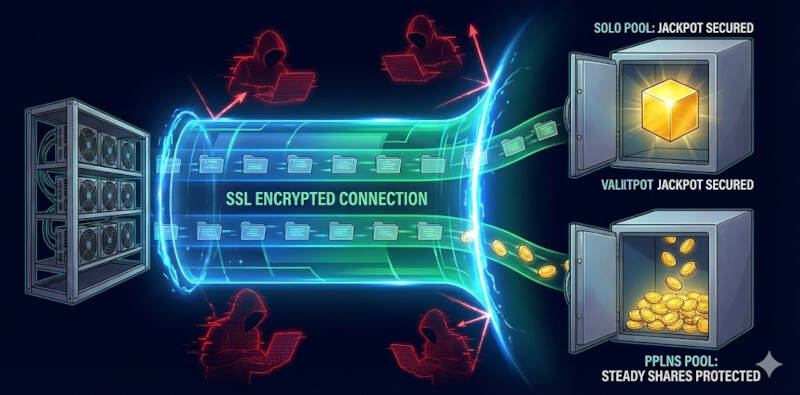
Securing the Jackpot: Why SSL is Essential for SOLO and PPLNS Mining Pools
In the competitive landscape of cryptocurrency mining, the difference between a profitable operation and a failing one often comes down to the details. While hardware choice is vital, the method of payout and the security of your connection are equally critical. Today, professional miners are moving away from legacy, unencrypted connections and shifting toward SSL-capable SOLO and PPLNS pools.
But why is this combination—SSL encryption paired with specific reward systems—the gold standard for security and efficiency? Let’s dive into the mechanics of these systems and why an SSL-encrypted pool is no longer an option, but a requirement.
1. Understanding the Reward Systems: SOLO vs. PPLNS
Before addressing security, we must understand the "how" of the earnings. Miners generally choose between two primary philosophies depending on their risk appetite and hardware power.
SOLO Mining: The High-Stakes Pursuit
SOLO mining is the "winner-takes-all" approach. When you mine solo, you aren't sharing the block reward with thousands of others. If your rig finds the block, the entire reward (plus transaction fees) belongs to you.
The Benefit: Zero sharing and maximum profit per block.
The Risk: High variance. You might go weeks without a reward. Because the stakes are so high, ensuring that your "winning share" actually reaches the pool without interference is paramount.
PPLNS (Pay Per Last N Shares): The Fair Efficiency
PPLNS is widely regarded as one of the fairest payout systems. Unlike PPS (Pay Per Share), which can be exploited by "pool hoppers," PPLNS only looks at a specific window of shares submitted before a block is found.
The Benefit: It rewards loyalty. The longer you stay on the pool, the more consistent your payouts become. It also generally has lower fees than PPS pools.
The Risk: If your connection is unstable or intercepted, your "N shares" window might be incomplete, leading to lower payouts.
2. The SSL Imperative: Why Encryption is Non-Negotiable
Whether you are chasing the big jackpot in SOLO or building steady gains in PPLNS, your connection is your lifeline. Standard Stratum protocols often transmit data in plaintext. This is a massive security hole. This is where SSL (Secure Sockets Layer), or more accurately TLS (Transport Layer Security), comes into play.
Protection Against Hashrate Hijacking
The most common threat to an unencrypted miner is "Hashrate Hijacking." In a Man-in-the-Middle (MitM) attack, a hacker intercepts the communication between your ASIC and the pool. They don't stop your machines; instead, they silently change the worker name in the data packets to their own address.
Your machines run hot.
Your electricity bill rises.
The attacker gets the payout.
With an SSL Pool, every packet is encrypted. An interceptor cannot read or modify the worker credentials, ensuring that every hash you generate is credited to your account.
Privacy from Network Service Providers (ISPs)
In some jurisdictions, cryptocurrency mining exists in a legal gray area or is subject to throttling by ISPs. Standard mining traffic is easily identifiable by deep packet inspection. SSL masks your mining traffic, making it appear as standard encrypted web traffic. This prevents targeted throttling and protects your operational privacy.
3. Efficiency Meets Security: The SSL Advantage
Many miners worry that SSL encryption adds "overhead" that might slow down their shares. However, modern mining software and pool infrastructure have optimized SSL to the point where the latency difference is negligible—often less than 1-2 milliseconds.
When you consider the "Efficiency Cost" of a hijacked connection (which is a 100% loss of revenue), the 0.1% overhead of SSL is the best insurance policy in the industry.
PPLNS Efficiency: SSL ensures that every share in your "N" window is valid and untampered, protecting your loyalty bonus.
SOLO Security: In SOLO mining, you might only find one block a month. If that specific "winning" packet is intercepted or corrupted because of an insecure connection, you lose everything. SSL acts as a digital armored truck for your winning block.
4. How to Choose the Right SSL Pool
When looking for a provider, look for the following "Green Flags":
Dedicated SSL Ports: The pool should provide specific ports (usually 4443, 5553, or similar) dedicated to SSL/TLS traffic.
Stratum V2 Support: Ideally, the pool supports Stratum V2, which integrates security by design.
Low Latency Endpoints: Ensure the pool has SSL-capable servers near your physical location to minimize stale shares.
Conclusion: Don't Mine Naked
Mining without SSL is like leaving your front door wide open in a busy city. You might not get robbed today, but it is only a matter of time. By choosing a SOLO or PPLNS pool with robust SSL capabilities, you are protecting your hardware investment, your electricity costs, and your hard-earned rewards.
In the world of crypto, the "Invisible Risk" is real. Encrypt your connection, secure your hashrate, and ensure that when you find that next block, it actually ends up in your wallet.

