
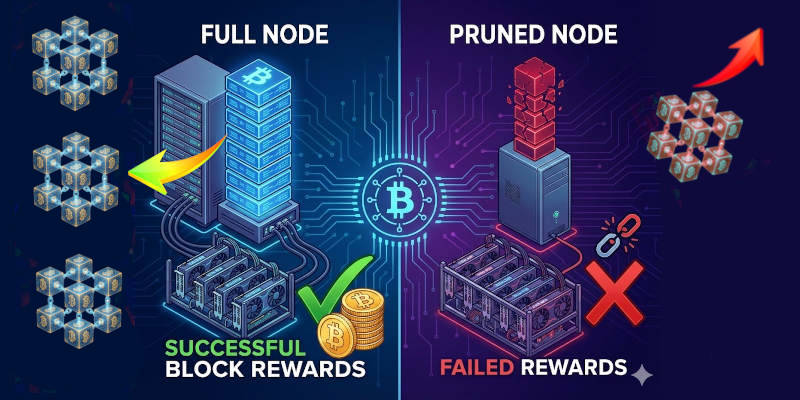
The Miner’s Fatal Mistake: Why Bitcoin Pruned Nodes Cannot Secure Block Rewards
Bitcoin Mining Full Node vs Pruned Mode? or the Block reward will be lost; In the high-stakes world of Bitcoin mining, efficiency is usually the top priority. Miners obsess over hash rate, electricity costs, and cooling solutions. However, there is a fundamental infrastructure requirement that is often overlooked by newcomers setting up independent mining operations: the type of Bitcoin node they are running.
If you are attempting to mine Bitcoin solo or running your own private pool, the most critical requirement is that your operation must connect to a full, non-pruned archival node.
There is a dangerous misconception that saving disk space by using a "pruned" node is an acceptable shortcut. This is false for miners. If your mining setup relies on a node with Prune activated, your attempts to generate new blocks will fail, and you will never successfully claim a Bitcoin block reward.
Here is a deep dive into why a full node is non-negotiable for successful mining and why cutting corners on storage will cost you a fortune in lost rewards.
Understanding the Bitcoin Node Landscape
To understand why mining requires specific infrastructure, we must first differentiate between the two primary ways of running Bitcoin Core. The Bitcoin blockchain is a ledger of every transaction in history, dating back to the Genesis Block in 2009. Currently, this data exceeds 833GB and is growing every day.
1. The Full Archival Node
A full archival node downloads, validates, and stores the entire history of the blockchain. It possesses every block and every transaction ever made. It is the ultimate source of truth on the network. Because it holds everything, it can serve historical data to other new nodes joining the network and can handle any query regarding past transactions.
2. The Pruned Node
A pruned node is designed for users with limited disk space. It downloads and validates the entire chain just like a full node, but once older data is verified, it deletes it. A pruned node might only keep the most recent few gigabytes of blockchain data.
For a regular user just wanting to send and receive Bitcoin securely and privately, a pruned node is perfectly fine. It can validate that incoming transactions follow the rules. However, for a miner, a pruned node is inadequate.
Why Pruned Nodes Fail at Mining
Mining is not just about guessing a random number (the nonce) as fast as possible. Before a miner can even begin hashing, they must construct a "candidate block."
This candidate block is filled with pending transactions waiting in the mempool. To ensure the block is valid, the miner's node must verify that every single Bitcoin being spent in those transactions actually exists and hasn't been spent before.
The Importance of the UTXO Set
To do this, the node relies on the UTXO set (Unspent Transaction Output set). This is the current database of who owns what. Both full nodes and pruned nodes maintain a complete UTXO set.
The Critical Failure Point
If pruned nodes have the UTXO set, why do they fail at mining?
The issue lies in the mining software's interaction with the node via RPC (Remote Procedure Calls) and the requirements for propagating a new block.
When your mining software attempts to build a block template, it needs absolute certainty that the data it is using is correct and that it can reference necessary data points. While a pruned node can validate incoming blocks, it struggles with the complex task of creating new ones.
Many mining software implementations rely on specific RPC calls that are disabled or severely limited when a node is running in pruned mode (such as gettxoutproof for older transactions). Furthermore, if your node successfully finds a block, it must rapidly propagate it to peers. Full nodes are preferred peers on the network because they can serve all data requests; pruned nodes are less capable peers.
If your node cannot assemble a perfectly valid block template because it is missing historical context that the mining software requires, or if it cannot verify certain dependencies due to missing data, the block you mine will be rejected by the rest of the network.
You will have spent electricity doing the work, found the correct hash, but your reward will be zero because the underlying block structure was flawed due to pruning.
Solo Mining vs. Pool Mining
It is important to make a distinction here regarding who is at risk.
Pool Miners: If you point your ASIC miner at a large public pool (like Gokby Pool, Foundry or Antpool), you do not need to run a node. The pool operator runs huge, full archival nodes. You are just contributing hash power.
Solo Miners & Private Pool Operators: If you are mining alone, hoping to capture that full 3.125 BTC reward yourself, you are the network operator. You must run your own node. In this scenario, running a pruned node is a guarantee of failure.
Conclusion: Don't Skimp on Storage
In the economics of Bitcoin mining, the cost of a 1TB or 2TB SSD to run a full archival node is negligible compared to the cost of mining hardware and electricity.
Trying to save roughly $100 on hard drive space by running a pruned node puts 100% of your potential revenue at risk. For miners, storage is not an optional extra; it is a fundamental requirement for success. To ensure your block rewards are successful, always run a full, non-pruned Bitcoin node.
## The Miner’s Infrastructure Checklist
Running a node is one thing; ensuring it is "mining-ready" is another. Use this checklist to verify your setup before you waste a single kilowatt of energy.
[ ] Pruning Status: Check your
bitcoin.conffile. Ensureprune=0is set or that the line is completely removed.[ ] Disk Space: Verify you have at least 900GB+ of free space (as of early 2026) to accommodate the full archival chain and future growth.
[ ] Indexing: Ensure
txindex=1is enabled. This allows the node to quickly reference any transaction, which many mining software packages require.[ ] Peer Connectivity: Ensure port 8333 is open on your router to allow for rapid block propagation once you find a solution.
[ ] RPC Credentials: Double-check that your mining hardware/software has the correct
rpcuserandrpcpasswordto communicate with the node.
## Visualizing the Validation Gap
To help you understand why the network rejects blocks from incomplete nodes, it helps to see how a node interacts with the rest of the ecosystem.
## Key Terminal Commands for Verification
If you are running your node via CLI, run these commands to confirm your status:
To check if pruning is active:
bitcoin-cli getblockchaininfo(Look for "pruned": false)
To check connection count:
bitcoin-cli getconnectioncount(Ideally, you want 8+ connections to ensure your found block reaches the network instantly.)
## Final Pro-Tip: The "Wait for Sync" Rule
Never start your mining equipment until your node is 100% synchronized. If your node is even a few blocks behind, your hardware will be mining on "old" information, resulting in Stale Blocks that the network will ignore.
Would you like me to draft a troubleshooting guide for common error codes that appear when mining software fails to connect to a Bitcoin node?

