
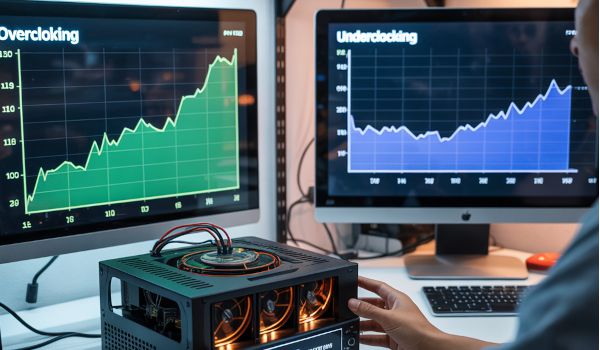
In the high-stakes world of cryptocurrency mining in 2026, the difference between a profitable operation and a literal "money pit" often comes down to a few millivolts. As Bitcoin network hashrates soar past 800 EH/s and electricity costs remain volatile, simply plugging in an ASIC (Application-Specific Integrated Circuit) is no longer enough. To survive, you must master ASIC Tuning.
This tutorial dives deep into the two primary schools of thought: Overclocking for maximum profit and Underclocking for peak efficiency.
The Silicon Lottery: Why Tuning Works
Not all ASIC chips are created equal.1 Due to minor imperfections during manufacturing, some chips can handle higher speeds at lower voltages than others—this is known as the Silicon Lottery. Factory settings are "conservative," designed to ensure the worst chips in a batch run stable. Tuning allows you to reclaim that lost potential based on your specific environment and goals.
Overclocking: Chasing the Bull Market Profit
Overclocking involves increasing the chip frequency beyond factory specifications to boost the total hashrate (TH/s).2
When to Overclock
Bull Market Cycles: When the price of the coin is skyrocketing, the increased rewards often outweigh the jump in your electricity bill.3
Fixed-Cost Electricity: If you have access to "stranded" energy or a fixed-price PPA (Power Purchase Agreement), every extra hash is pure margin.
Aging Hardware: Overclocking can keep older machines like the Antminer S19 series competitive against newer models.4
The Risks
Overclocking is not free. Power consumption increases exponentially, not linearly.
The Golden Rule: A 15% increase in hashrate through overclocking can result in a 30-40% increase in power draw.
Underclocking (Undervolting): The Efficiency Play
Underclocking (or more accurately, undervolting) is the process of lowering both frequency and voltage to find the "Efficiency Sweet Spot."
Why Efficiency is King in 2026
In a post-halving environment, your most important metric isn't TH/s; it's Joules per Terahash (J/TH).5 By undervolting, you can often achieve 80% of your hashrate while using only 60% of the power.
Benefits of Underclocking
Reduced Heat: Lower voltage means less thermal stress on the chips, significantly extending the lifespan of your hardware.6
Lower Noise: Fans can run at 40-50% speed rather than 100%, making "home mining" viable.
Stability: Underclocked machines rarely crash, leading to higher "uptime" which often yields more profit than a shaky overclocked rig.
How to Tune Your ASIC: A Step-by-Step Tutorial
1. Install Custom Firmware
Factory firmware is often locked. To tune, you’ll need third-party firmware such as LuxOS, Vnish, or Braiins OS+. These allow for "Auto-Tuning," where the software analyzes each individual chip to find its peak performance.
2. Check Your Infrastructure
PSU Limits: Ensure your Power Supply Unit can handle the extra load if overclocking.7
Ambient Temp: Overclocking in a room above 30°C (86°F) is a recipe for hardware failure.
3. Incremental Adjustments
Start at Stock: Record your baseline hashrate and wattage.8
Adjust Frequency: Increase or decrease in 5-10 MHz increments.
Monitor HW Errors: Watch the "Hardware Error" rate. If it exceeds 0.5%, your voltage is too low for that frequency.
Finalize: Once stable for 24 hours, you’ve found your profile.
| Mode | Hashrate (Target) | Power Draw | Efficiency (J/TH) | Best Use Case |
| Overclock | 120% | 145% | 25-28 | Bull Market / Cheap Power |
| Stock | 100% | 100% | 21-23 | General Purpose |
| Efficient | 85% | 65% | 16-18 | Bear Market / High Power Cost |
Decision Matrix: Which One Should You Choose?
To decide your strategy, use the Profitability Threshold formula:
If $Electricity Cost > \$0.08/kWh$, underclocking for efficiency is almost always the winning strategy. If your cost is below $\$0.04/kWh$, push those chips to the limit!
Final Thoughts
Tuning is no longer an "extra" for hobbyists; it is a fundamental requirement for industrial mining. Whether you choose the raw power of overclocking or the surgical precision of undervolting, remember that stability is the ultimate goal. A machine that hashes steadily for 365 days will always outperform a "monster" rig that crashes every weekend.
Would you like me to create a custom profitability spreadsheet template for your specific ASIC models?

