
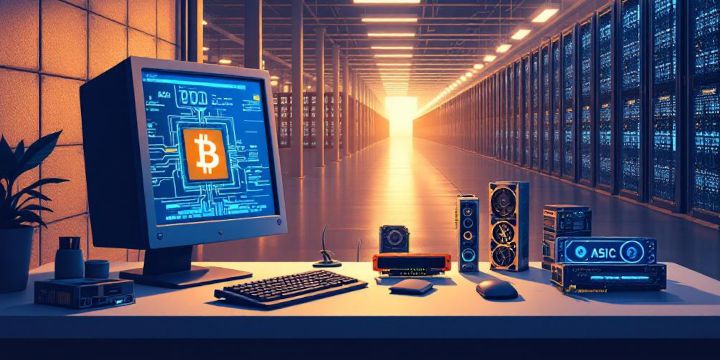
From CPUs to Warehouses: A Brief History of Bitcoin Mining
The story of Bitcoin mining is one of the fastest technological "arms races" in human history. In just under two decades, the process of securing the world’s most famous decentralized network has transformed from a hobbyist experiment in bedrooms to a multi-billion-dollar industrial powerhouse.1
If you are looking to understand how we went from "one CPU, one vote" to massive, liquid-cooled data centers, this guide will take you through every major era of the Bitcoin mining evolution.
1. The CPU Era (2009–2010): The Age of the Hobbyist
When Satoshi Nakamoto released the Bitcoin whitepaper, the vision was simple: anyone with a personal computer could contribute to the network.2During the first year, mining was performed using Central Processing Units (CPUs)—the same chips that run your web browser and word processor.3
Key Milestone: On January 3, 2009, Satoshi mined the Genesis Block using a standard PC.4
The Vibe: Mining was essentially a background task for tech enthusiasts.5Competition was so low that you could mine hundreds of Bitcoin with a basic laptop.6
+1
2. The GPU Revolution (2010–2011): Parallel Power7
As Bitcoin gained a small following, miners realized that CPUs were "jacks of all trades" but masters of none. Graphics Processing Units (GPUs), designed to render complex video game graphics, were far better at the repetitive mathematical guesses required for the SHA-256 algorithm.8
A single GPU could perform more hashes per second (hashrate) than dozens of CPUs combined.9 This shift marked the first major jump in mining difficulty and the birth of "mining rigs"—open-air frames filled with multiple humming graphics cards.
3. The FPGA Bridge (2011–2012): Customization Begins10
The "arms race" accelerated with Field-Programmable Gate Arrays (FPGAs).11 These were unique because the hardware could be "programmed" specifically for mining.
While FPGAs didn’t always offer a massive speed boost over high-end GPUs, they were significantly more energy-efficient.12 This was the first time miners began to prioritize "Joules per Terahash," realizing that electricity costs were the true enemy of profitability.
4. The ASIC Dominance (2013–Present): Specialized Silicon13
The game changed forever in 2013 with the arrival of Application-Specific Integrated Circuits (ASICs).14Unlike GPUs or CPUs, an ASIC cannot play a video game or write an email.15It is a chip built for exactly one purpose: solving the SHA-256 algorithm.16
The leap in efficiency was so great that every other form of hardware became obsolete almost overnight. Companies like Canaan Creative and Bitmain emerged as the new titans of the industry, producing machines like the legendary Antminer series.17
Note: The introduction of ASICs effectively ended "home mining" for the average person, as the cost of hardware and electricity became too high for a single enthusiast to compete.
5. The Warehouse Era: Mining at Institutional Scale
As of 2026, Bitcoin mining has moved almost entirely into warehouses and industrial data centers. These facilities are no longer located in garages but in regions with the cheapest possible energy—often near hydroelectric dams or wind farms.18
Modern Mining Trends:
| Feature | Description |
| Immersion Cooling | Submerging ASICs in non-conductive liquid to manage heat and increase lifespan. |
| Grid Balancing | Miners acting as "load sinks" for power grids, using excess renewable energy that would otherwise go to waste. |
| Public Companies | Large-scale mining operations like Riot Platforms and Marathon Digital are now publicly traded on the NASDAQ. |
The Future: Decentralization vs. Efficiency
While the shift to warehouses has led to concerns about centralization, the industry is currently pivoting toward sustainability. Today’s miners are increasingly focusing on "green mining," utilizing flared gas from oil fields or excess solar power to secure the network.19
The journey from a single laptop in 2009 to a 100-megawatt warehouse in 2026 shows just how far Bitcoin has come. It is no longer just a digital currency; it is the primary driver of a new global energy and computing infrastructure.
TAG:
- Bitcoin mining history
- CPU mining
- GPU mining
- ASIC mining
- Cryptocurrency mining evolution
- Industrial Bitcoin mining
- Mega-farm mining
- Corporate crypto mining
- Blockchain technology
- Energy-efficient mining
- Evolution of crypto mining hardware
- Bitcoin mining warehouses
- ASIC miners
- SHA-256 history.

