
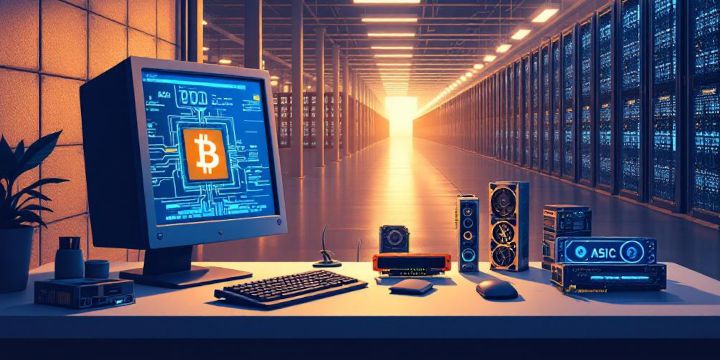
From CPU to ASIC: The Incredible Evolution of Bitcoin Mining
In 2009, Satoshi Nakamoto mined the first Bitcoin block (the Genesis Block) using a simple computer CPU. For a while, anyone with a laptop could mine hundreds of Bitcoin a day.
Today, that is impossible. Let's look at the rapid Darwinian evolution of mining hardware.
Era 1: CPU Mining (2009-2010)
In the beginning, mining was done by the processor (Central Processing Unit) of a normal PC. It was democratic—one computer, one vote.
- Hashrate: Less than 10 MH/s.
Era 2: GPU Mining (2010-2012)
Laszlo Hanyecz (the guy who bought the pizza) figured out that Graphics Cards (GPUs) were much better at the specific math Bitcoin uses (SHA-256).
Suddenly, gamers were building rigs. Difficulty skyrocketed. CPU miners were pushed out.
- Hashrate: Hundreds of MH/s per card.
Era 3: FPGA (2011-2012)
Field Programmable Gate Arrays. These were custom chips that could be reprogrammed. They were more efficient than GPUs but hard to configure. This was a short-lived bridge era.
Era 4: The ASIC Age (2013-Present)
Application Specific Integrated Circuit.
Engineers realized: "Why make a chip that can do graphics AND math? Let's make a chip that does ONLY SHA-256 math and nothing else."
The first ASICs arrived, destroying GPU mining overnight. Today, machines like the Antminer S21 are thousands of times more powerful than the best supercomputers of 2010.
What’s Next?
We are now in the era of efficiency. It's not just about speed anymore; it's about Joules per Terahash. We are reaching the physical limits of silicon chips.
This is good for decentralization. Since hardware isn't becoming obsolete every 6 months anymore, home miners can buy a machine and run it for years.

